Mindful Resilience
Actively promote resilience training and other mental health resources for firefighters to support their overall well-being.
Related Pillar and Perspective:
- Health and Wellness
- Firefighter Well-Being
Inside the New Firefighter Life Safety Initiative 4
Combines these original initiatives:
- Counseling and Support
- Medical and Fitness Standards
The revised Life Safety Initiatives Matrix was developed to better respond to the evolving needs of the nation’s fire service. The original 16 initiatives were evaluated, restructured, and consolidated into 12 initiatives, organized under four primary pillars and addressed from three distinct perspectives. The result is a more comprehensive and adaptable framework designed to guide behavior and decision making that prioritizes continuous learning and supports the integration of new knowledge, techniques, and technologies.
This month, attention turns to Life Safety Initiative #4: Mindful Resilience, positioned under Pillar II: Health and Wellness and examined through the Firefighter Well-being perspective. This initiative highlights the essential role of mental, emotional, and behavioral resilience in sustaining a healthy, high‑performing fire rescue service. It recognizes that the demands of the profession whether it be operational, organizational, or personal, require intentional practices that strengthen wellbeing, support recovery, and enhance long‑term performance.
Mindful Resilience emphasizes:
- Proactive mental wellness practices — encouraging firefighters and fire rescue agencies to adopt daily habits that build psychological strength, reduce stress, and support healthy coping strategies before challenges escalate.
- Accessible behavioral health resources — ensuring that every member has timely, stigma free access to counseling, peer support, and evidence based interventions that address the unique stressors in fire rescue.
- A culture that normalizes help seeking — promoting open dialogue, supportive leadership, and organizational systems that reinforce the message that seeking support is a sign of professionalism.
LSI #4 recognizes that resilience is not an individual responsibility alone. It is a shared commitment that strengthens teams, improves decision making under pressure, and enhances safety on and off the emergency scene. When firefighters are mentally prepared, emotionally supported, and equipped with healthy coping tools, they face fewer preventable risks, communicate more effectively, and maintain clearer situational awareness during high‑stress events.
Mindful resilience also contributes to long‑term wellbeing by reducing burnout, mitigating the cumulative impact of trauma exposure, and fostering a sense of purpose and connection within the organization. When fire rescue organizations prioritize mental wellness, encourage open communication, and integrate resilience practices into daily operations, the entire profession becomes stronger, safer, and more sustainable. – Danny Kistner, Director of the Institute for Firefighter Survivability
More About Initiative #4
Initiative Article Spotlight
- Crackyl: Building Resilience: A Comprehensive Guide for Firefighters
- Fire Engineering: Firefighter Stress Resilience and Increasing Emotional Bandwidth
- Fire Engineering: The Resilient First Responder
- Fire Engineering - Upstream Practices That Predict Firefighter Resilience
- FireRescue1com: Gratitude for resilience: Seeing the forest despite the trees
- Firefighter Nation: The Impact of Mindfulness in Motion on Firefighter Hypervigilance
- Firefighter Nation: The Impact of Mindfulness in Motion on Firefighter Hypervigilance
- MDPI: Strategies to Improve Physiological and Psychological Components of Resiliency in Firefighters
- National Institute of Health: Role of Resilience in Mindfulness Training for First Responders
Book Spotlight
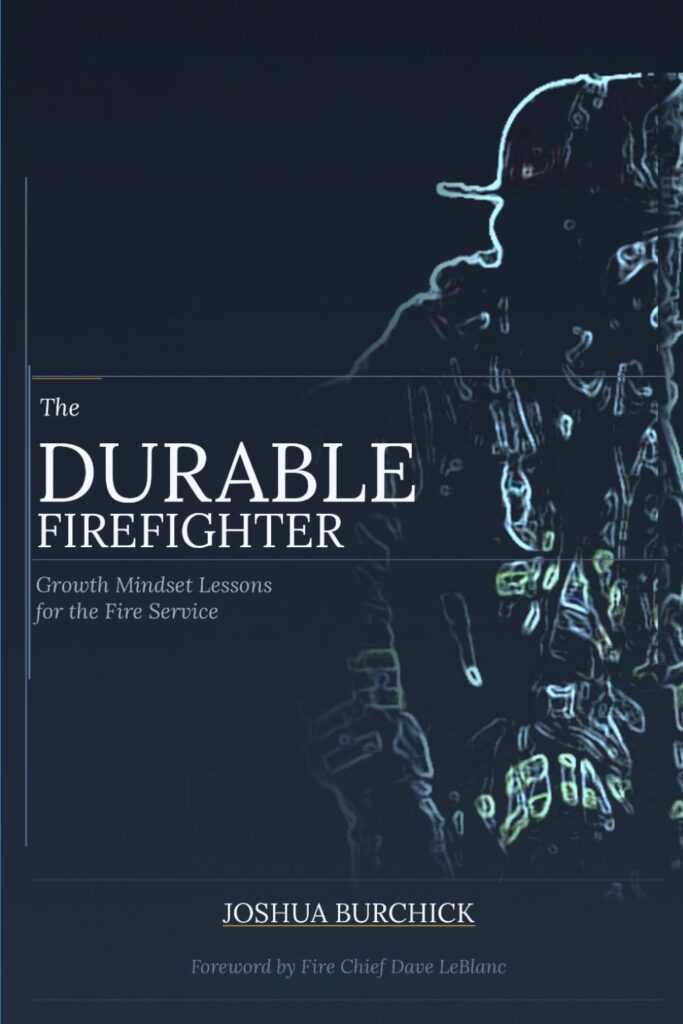
Firefighter and officer Joshua Burchick survived one of the most harrowing incidents of his career and emerged with a mission: to build durable, resilient firefighters through physical, mental, and emotional performance.
The Durable Firefighter is a field manual for an authentic life of service. Drawn from three years of widely read weekly essays, it distills leadership science, stoic philosophy, neuroscience, and hard-won fireground experience into practical lessons across four pillars — Leadership, Mindset & Philosophy, Developing Skill, and Wellness.
* Your purchase through our Amazon Associates program will benefit the programs of the National Fallen Firefighters Foundation to honor America’s fallen fire heroes; support their families, colleagues, and organizations; and work to reduce preventable firefighter death and injury.
Podcasts




Action-Steps for Firefighters & Fire Officers
For Firefighters:
Break the stigma
- All members have to embrace the understanding that our mental wellness is as important as our physical health.
- Sharing your experiences with trusted peers shows strength, builds resilience, and fosters perseverance.
- Emotional balance helps firefighters remain calm and make effective decisions on the fireground.
For Company Officers:
The aggressive listener
- The company officer must recognize that their own emotions matter; model the behavior they expect from their members, stabilize, and call for additional resources.
- Most critically, in a time where distractions are many, the leader must not be just an active listener, they must be an aggressive listener, seeking to encourage their firefighters to communicate.
- The company officer must learn (and be able to teach) mood-stabilizing mindfulness practices such as box breathing or the 4, 7, 8 breathing techniques. Breathe in for 4 seconds, hold for 7 seconds, breathe out for 8 seconds. Focus your attention on your breath.
- Once you gain control of your focus, you can then be present for others.
For Chief Officers: Fostering a culture that values mental health
- Organizational leaders are responsible for developing a framework that highlights the importance of mental wellness.
- Making it clear that at every level of the organization the expectation is to support all efforts dedicated to increasing mental wellness.
- The number of avenues offered to the fire service to gain information and build systems has increased exponentially over the last several years. Leverage resources, such as the First Responder Center for Excellence, firstrespondercenter.org
Family: The vital link between the firehouse and the home
- The home is our foundation. Recognize that stressors impact both the firefighter and the family with equal weight; when one partner suffers, the whole home is impacted.
- Prioritize open communication. Encourage one another to seek help early and normalize discussing the unique challenges of the job.
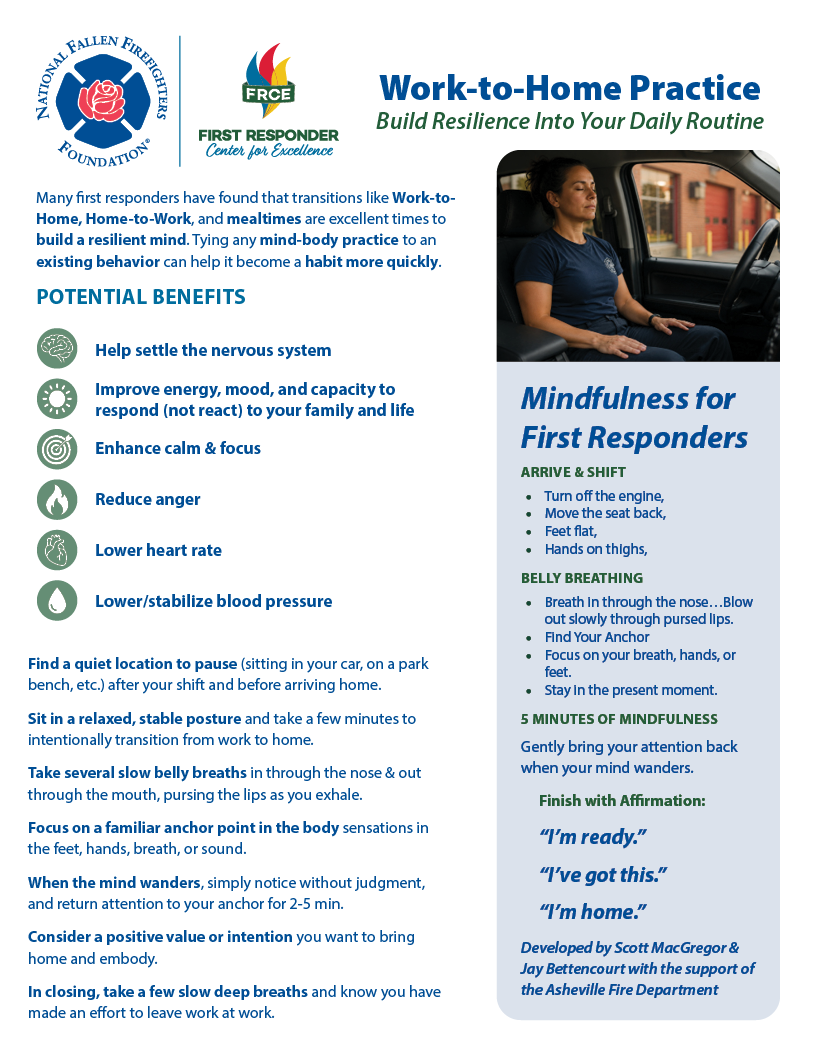
- Create a transition routine. Engage in a brief mindfulness practice in your vehicle upon arriving at work or home to decompress and mark the boundary between spaces.
Credit Hours: 1 Hour
Credit Hours: 1 Hour
Credit Hours: 1 Hour
Credit Hours: 1 Hour
Credit Hours: 1 Hour
Credit Hours: 1 Hour
Credit Hours: 1 Hour
Credit Hours: 1 Hour
Credit Hours: 1 Hour
Credit Hours: 1 Hour
Find research and resources on health, wellness, nutrition, fitness, physicals, cancer, and cardiac at www.firstrespondercenter.org
The FRCE is dedicated to protecting the lives and livelihoods of first responders, nationwide. Our education and research initiatives constantly shed new light on challenges to the health, safety and well-being of firefighters, EMS personnel and other first responders. It’s all with the goal of reducing line-of-duty injuries and deaths as well as occupational illnesses.
Your feedback on Initiative #4 (Mindful Resilience) will help departments nationwide strengthen policies, increase community engagement opportunities and encourage action which aligns with best practices. This survey takes less than 2 minutes.
Initiative #4 Feedback
Help us improve Mindful Resilience in fire rescue!